We make AI-assisted development legible for your team.
Your agents are writing code faster than anyone can read it. We build the cockpit that keeps a small team in control of the work — what’s planned, what’s been reviewed, what the team has learned — so speed doesn’t cost you the thread.
On self-recognition
Does this sound like you?
Your agents ship more in a day than your team can review in a week — and nobody’s quite sure what got merged.
Decisions get made in a chat window at 2am and forgotten by standup. The same questions get re-litigated every sprint.
“The plan” lives in someone’s head, three tickets, and a Slack thread — and they don’t agree.
A worktree gets deleted, and a half-finished plan goes with it.
You can’t tell, at a glance, which AI-generated work a human has actually checked.
Onboarding a developer means explaining context nobody wrote down — because the agent “just knew” it.
The problem isn’t the agents. It’s that nobody can see what they’re doing.
On the proof
We built our own. It’s how we know this works.
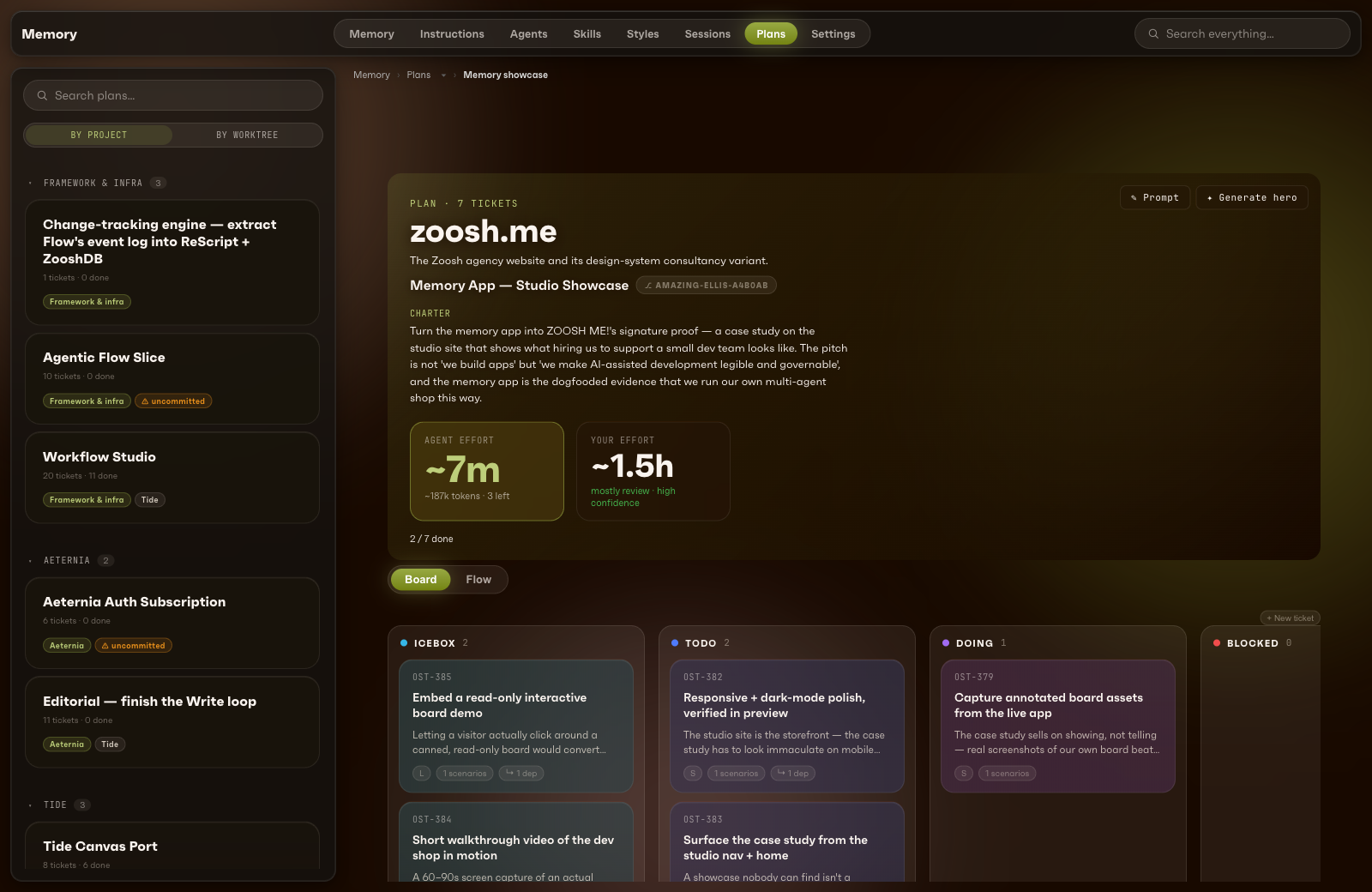
The memory app is the cockpit we run the studio on — every plan, every agent, every decision, on one board. It isn’t a product we’re selling you; it’s how we know this works.
The board — every plan, every agent, every decision in one place.
Plans as tickets, not prose.
Every body of work decomposes into cards you grok in five seconds — each carrying its own reasoning, acceptance criteria, and dependencies.
A review axis separate from status.
“Done” is what the agent thinks. “Approved” is what a human decided. The two stop getting confused.
Team memory that’s committed, not remembered.
The hard rules, the gotchas, the why-we-did-it-this-way — kept in version control and surfaced where you work.
Worktree-aware.
It sees every branch in flight at once, so parallel agent work never hides from the team.
Nothing gets lost.
At-risk plans are backed up and recoverable — even after a worktree is deleted.
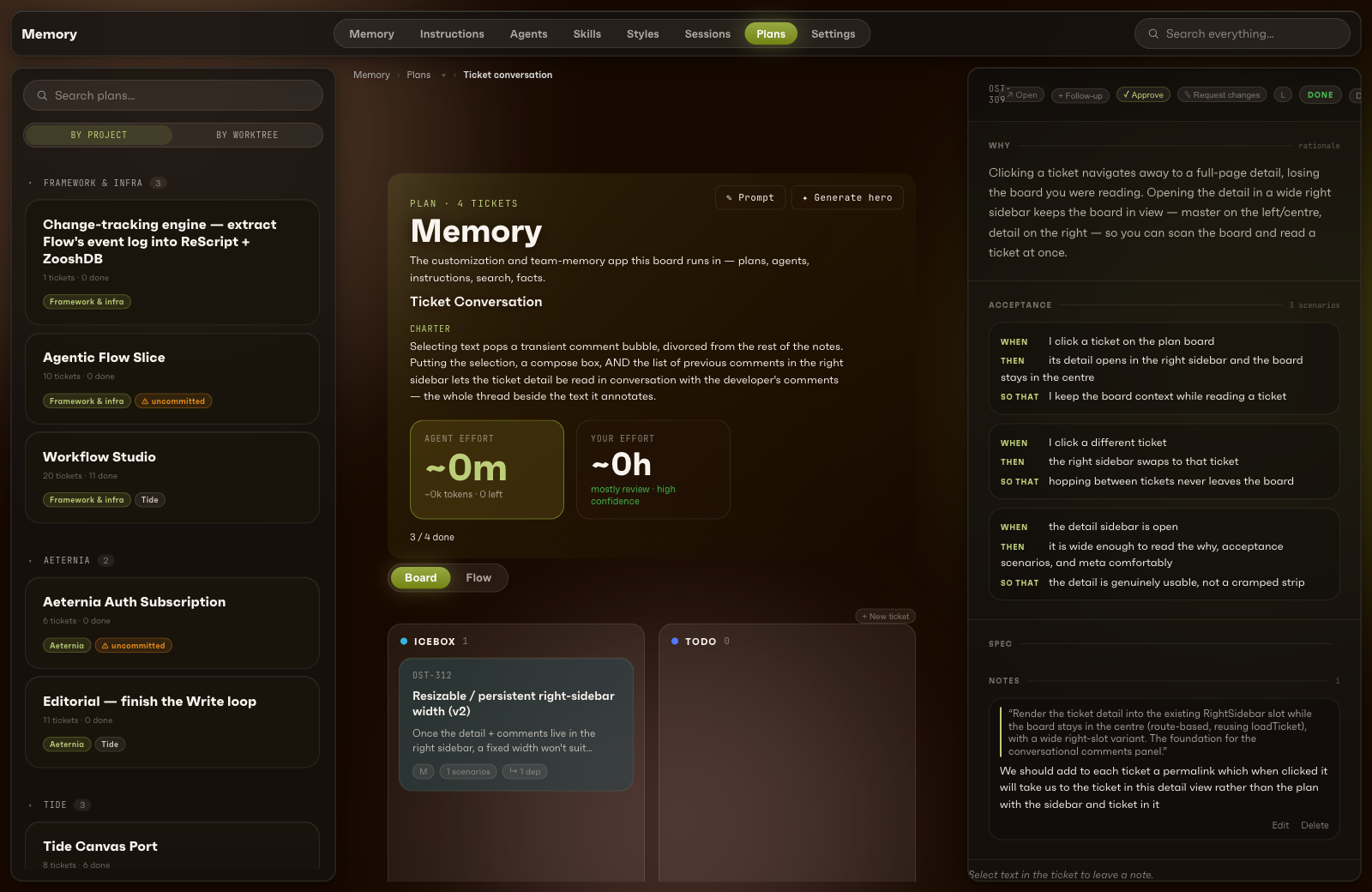
One ticket, fully legible — the reasoning, the acceptance criteria, the review verdict, and the developer’s margin notes, side by side.
On method
How we work — four phases, one system.
Step 01
We learn how your team actually ships.
Where do agents help, where do they make mess, what does your team keep re-explaining? The real workflow is never the one in the README.
Step 02
We set up the cockpit around your stack.
Your conventions, your design system, your review gates — encoded, so the board reflects how you actually work instead of a generic template.
Step 03
We make the agents legible.
Plans become reviewable cards; agent output lands where a human signs off; decisions get written down once and reused.
Step 04
We hand it over, and stay close.
We train your team, document the setup, and stay available as your process grows. The cockpit is yours.
What you get
What hiring us looks like.
01
A working agentic-dev cockpit
Tailored to your team and your stack — not a template.
02
A planning discipline
Plans-as-tickets your whole team can read in five seconds.
03
A review + memory layer
So AI output is governed, not just generated.
04
Design-system discipline
So what ships looks like one product, not ten prompts.
An invitation
Hire a Glasgow studio that builds its own tools this way — and will build yours.
The first conversation is free and has no prep. Tell us how your team works with agents — we’ll tell you honestly where a cockpit would help and where it wouldn’t.
Talk to usNo pitch. No prep. Just a conversation about how your team ships.